
Building a traditional Turkish bath requires more than creating a beautiful interior. A hammam must handle high humidity, heat, water exposure, curved surfaces, seating areas, ceilings, niches, and decorative finishes. The construction system must therefore be planned carefully from the beginning.
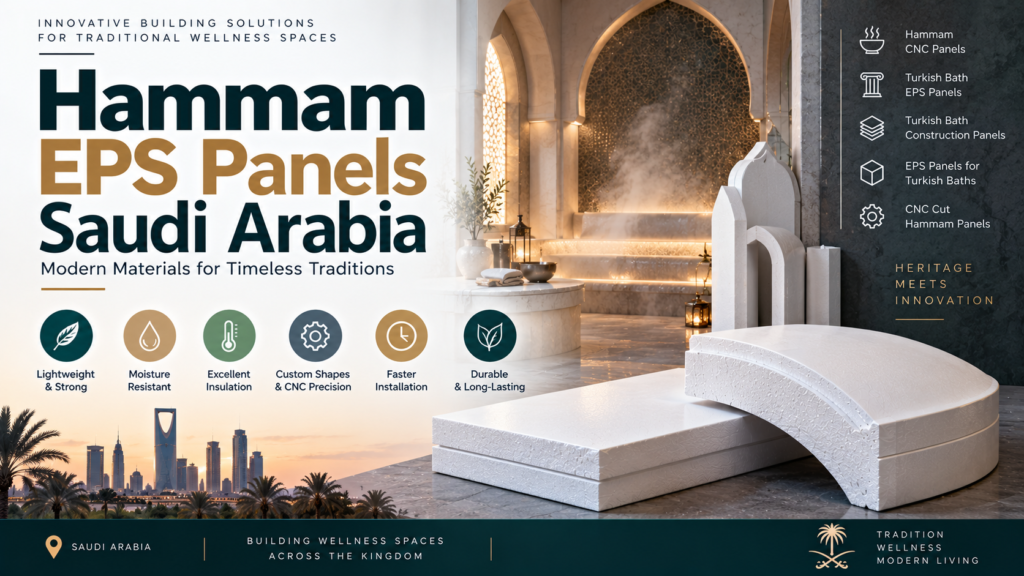
This is where Hammam EPS panels Saudi Arabia can be used as part of a modern hammam construction system. These lightweight construction boards can be shaped and assembled to create walls, benches, ceilings, partitions, arches, niches, and other forms required in a Turkish bath.
Unlike conventional masonry, Turkish bath EPS panels can be CNC-cut into specific shapes before installation. This makes it possible to produce accurate components for projects with unusual dimensions or customized designs.
In this guide, we will explain how Hammam EPS panels Saudi Arabia are used in Turkish bath construction, what CNC cutting has to do with the process, where these panels can be installed, and what beginners should understand before starting a hammam project.
Hammam EPS panels Saudi Arabia are lightweight construction panels that use expanded polystyrene (EPS) as a core or structural shaping material, usually combined with suitable reinforced surface layers depending on the specific panel system.
EPS is a lightweight material that can be cut into different shapes. This makes it useful when a project requires curved surfaces, customized dimensions, sloped sections, or decorative architectural elements.
In Turkish bath construction, the panels are not simply used as exposed foam. They are normally part of a complete construction system in which the finished surface is reinforced and prepared for the required waterproofing, tiling, stone, plaster, or other finish.
This distinction is important for anyone researching Turkish bath EPS panels for the first time.
The panel itself is only one component of the construction system. The complete assembly must be designed according to the project’s structural, waterproofing, thermal, fire, and finishing requirements.
A traditional hammam contains many shapes that can be difficult and time-consuming to create using conventional masonry.
For example, a project may require:
Traditional construction can create these features, but it may require more cutting, shaping, blockwork, plastering, and adjustment on site.
EPS panels for Turkish baths offer another approach. Components can be prepared according to drawings and then assembled at the project location.
This is particularly useful when the design contains several repeated or precisely shaped elements.
The main idea is simple:
Design → CNC cutting → Panel preparation → Installation → Reinforcement → Waterproofing → Surface finishing
The exact sequence can vary depending on the construction system and manufacturer’s specifications.
The use of Hammam EPS panels Saudi Arabia generally begins during the design stage rather than after construction has already started.
The dimensions of the hammam, wall locations, seating, ceiling geometry, service points, and finishing requirements need to be considered before panels are fabricated.
The process can be divided into several stages.
The available space is measured first.
This includes:
Accurate measurements are important because CNC-cut components are produced according to specific dimensions.
The measurements are converted into drawings.
At this stage, the designer can determine where Turkish bath construction panels will be required.
For a customized hammam, the drawings may include individual components for benches, curved walls, ceiling sections, niches, and other features.
Once the design is finalized, the required shapes can be cut from EPS using CNC equipment.
This is where Hammam CNC panels become particularly useful.
Instead of manually cutting every piece on site, the CNC machine follows digital design information to produce the required shapes.
The prepared panels are transported to the construction site and assembled according to the installation plan.
The exposed panel surfaces are prepared according to the specified system.
Depending on the manufacturer’s system, this can include reinforced coatings or other surface treatments.
A hammam needs careful moisture management.
The appropriate waterproofing system, joints, penetrations, drainage details, and surface finish must be installed according to the project’s specifications.
Tiles, mosaics, stone, or another approved finish can then be applied.
One of the most straightforward applications of EPS panels for Turkish baths is wall construction.
A hammam wall may need to accommodate plumbing, niches, seating connections, decorative elements, and different surface levels.
Panels can be designed around these requirements.
For example, a wall may include a recessed niche for decorative lighting or toiletries. Instead of constructing the entire niche separately with masonry, a CNC-cut panel component can be prepared for the required shape.
This can make customized designs easier to execute.
However, the panel system must still be installed correctly. Joints, corners, penetrations, waterproofing, and finishing should not be treated as minor details.
In a humid environment, poor detailing can create problems even when the basic wall construction is sound.
Seating is one of the defining features of many Turkish baths.
A hammam may include:
Creating these shapes with conventional materials can involve several construction stages.
CNC cut Hammam panels can be produced to create the basic geometry of customized seating.
For example, a curved bench can be divided into several shaped components that fit together to create the required form.
After assembly, the surface needs to be properly reinforced, waterproofed, and finished according to the selected construction system.
The final tile or stone surface is what visitors see. The EPS component remains behind the finished surface as part of the construction assembly.
The ceiling is another area where Hammam EPS panels Saudi Arabia can be particularly useful.
Traditional hammams often feature curved ceilings, domes, arches, or other geometric forms.
These shapes can be difficult to create accurately using ordinary flat construction materials.
CNC technology allows complex EPS shapes to be cut according to a digital model.
For example, several CNC-cut sections can be produced and assembled to form a curved ceiling.
This approach can help designers create:
The design still needs to account for lighting, ventilation, steam distribution, access points, waterproofing, and finishing.
A visually attractive ceiling is not enough. It must also work as part of the complete hammam environment.
Modern Turkish baths often combine traditional architectural forms with contemporary interiors.
Niches and arches are common examples.
Turkish bath EPS panels can be shaped into customized components for these features.
A CNC machine can cut an opening or curved profile according to a digital drawing. This is useful when the project requires several identical shapes.
For example, a hammam may have three decorative wall niches with the same dimensions.
Rather than manually measuring and shaping each niche separately, the components can be digitally designed and CNC-cut.
This can help maintain consistency between the different elements.
The term Hammam CNC panels refers to EPS-based or similar panel components that have been shaped using computer-controlled cutting equipment for a hammam project.
CNC stands for Computer Numerical Control.
The basic principle is straightforward.
A digital design is prepared first. The CNC machine then follows the programmed cutting path to create the required shape.
This can be useful for producing:
The biggest advantage is not simply that the machine cuts foam. The important part is that the cutting process can follow a precise digital design.
This is why CNC cut Hammam panels can be useful for projects where accurate shapes and repeatable components are required.
The production process generally begins with the hammam design.
The required component is modeled or drawn digitally.
Its dimensions, angles, curves, openings, and other specifications are defined.
The digital design is converted into machine-readable cutting information.
The appropriate EPS material is prepared for cutting.
The required material specifications should be selected according to the intended application and manufacturer’s recommendations.
The CNC machine cuts the material according to the programmed design.
This produces the required shape more consistently than repeatedly measuring and manually cutting components.
The finished component is checked against the design dimensions.
The components are transported to the project and assembled according to the installation drawings.
This workflow is one reason Hammam CNC panels are useful for customized Turkish bath projects.
Installing EPS panels for Turkish baths is not simply a matter of attaching foam boards to a wall.
A complete construction system needs to be considered.
Depending on the specific product, installation may involve:
Special attention should be given to corners and penetrations.
Areas around plumbing, drains, electrical fixtures, doors, and other openings can become vulnerable points if they are not properly detailed.
For this reason, Turkish bath construction panels should always be installed according to the specific manufacturer’s technical instructions.
Saudi Arabia presents unique project conditions that should be considered during hammam planning.
However, the correct panel specification depends on the actual project rather than simply the location.
Before selecting Hammam EPS panels Saudi Arabia, consider the following.
A hammam is a high-humidity environment.
The complete wall and ceiling assembly should be designed to manage water and vapor appropriately.
EPS should not be treated as a substitute for a complete waterproofing system.
Waterproofing must be designed around the complete assembly, including joints, corners, penetrations, floors, benches, and drainage areas.
Different EPS products and panel systems have different fire characteristics.
Always check the applicable product documentation and project requirements before specifying a panel.
A hammam needs controlled heat and steam conditions.
The construction assembly should be selected according to the thermal requirements of the project.
The final finish can affect the construction system.
Tiles, mosaics, stone, plaster, and other finishes may have different installation requirements.
Not every EPS panel is designed to perform the same function.
Some systems are intended primarily for shaping and construction, while others have specific reinforcement or load-bearing characteristics.
The intended use should always match the manufacturer’s technical specifications.
When correctly specified and installed, Turkish bath EPS panels can provide several practical advantages.
EPS is significantly lighter than many conventional masonry materials.
This can make handling and positioning easier during construction.
The material can be shaped into different geometries.
This is especially useful for curved hammam designs.
CNC cut Hammam panels can be manufactured according to digital designs.
This is useful when accurate custom components are required.
Complex components can be prepared before reaching the site, reducing the amount of manual shaping required during installation.
Designers can create customized benches, arches, niches, ceilings, and other architectural forms.
When several identical components are needed, CNC production can help maintain consistency.
Not necessarily.
This is an important point for beginners researching Hammam EPS panels Saudi Arabia.
The suitability of a panel depends on its specifications and the complete construction system.
A project should consider:
A supplier or contractor should be able to provide the relevant technical information for the specific panel system.
The goal should not be to choose an EPS panel simply because it is lightweight. The complete system must be appropriate for the environment in which it will be installed.
The biggest value of Hammam EPS panels Saudi Arabia is the ability to combine lightweight construction with customized shapes.
A project can begin with a basic architectural concept and progress into detailed digital drawings. Those drawings can then be used to produce Hammam CNC panels and other custom components.
The panels can form the basic geometry of walls, benches, ceilings, arches, niches, and other features.
After installation, reinforcement, waterproofing, and finishing transform the basic panel structure into the finished hammam interior.
This is particularly useful for projects where traditional Turkish bath aesthetics need to be combined with modern construction methods.
Hammam EPS panels Saudi Arabia can be an effective component of modern Turkish bath construction when they are selected and installed as part of a properly designed system.
Their main advantage is flexibility. EPS panels for Turkish baths can be shaped into complex forms, while CNC technology makes it possible to produce customized components with consistent dimensions.
From curved benches and domed ceilings to arches and decorative niches, CNC cut Hammam panels can help turn detailed architectural designs into practical construction components.
At the same time, the panels are only one part of the overall construction process. Waterproofing, reinforcement, thermal performance, fire requirements, drainage, finishing, and installation details are equally important.
For anyone planning a Turkish bath, understanding Turkish bath construction panels, Turkish bath EPS panels, and Hammam CNC panels is a useful first step toward making informed construction decisions.
When the design, panel system, CNC fabrication, installation, and finishing are coordinated from the beginning, EPS-based construction can provide the flexibility needed for both traditional and contemporary hammam designs.
The performance of a hammam depends heavily on the quality and precision of its construction materials. High-density EPS panels can be CNC-cut according to project requirements, allowing manufacturers to produce customized walls, benches, ceilings, niches, and other components. To understand how precision manufacturing improves EPS panel production, read our guide on EPS Panel Manufacturer Saudi Arabia.