
Modern wellness projects require more than attractive finishes. A steam room must manage heat, humidity, water, insulation, structural requirements, and installation details at the same time. For hotels, spas, resorts, fitness clubs, and luxury residential projects, the construction method can have a major effect on project time, thermal performance, design flexibility, and long-term maintenance.
Steam room EPS panels have become an important alternative to conventional construction methods such as brick, concrete, cement board, and traditional framed assemblies. EPS, or expanded polystyrene, is a lightweight insulation material that can be manufactured in different densities, thicknesses, and shapes. The EPS Industry Alliance notes that EPS used in construction offers properties including thermal resistance, dimensional stability, compressive strength, and moisture resistance.
However, choosing between EPS-based construction and traditional construction should not be based on material cost alone. A proper comparison should consider the complete construction process, including material handling, fabrication, installation, insulation, waterproofing, finishing, and customization.
This guide compares both approaches and explains where EPS panels for steam rooms, precision CNC fabrication, and conventional construction differ.
Steam room EPS panels are lightweight construction components made from expanded polystyrene and manufactured for insulated wellness environments. Depending on the system, they can be fabricated into wall sections, ceiling elements, benches, niches, curved components, and other parts of a steam room.
The important point is that EPS panels are not simply insulation boards placed inside an ordinary room. In a purpose-designed system, panels can become part of the construction assembly and provide a base for additional waterproofing, reinforcement, and decorative finishes.
EPS is widely used in construction because of its low weight and insulating properties. The EPS Industry Alliance states that EPS can be used in walls, floors, and ceilings and can help control heat transfer and moisture when incorporated into suitable building assemblies.
For a steam room, however, the complete assembly matters. The EPS core alone should not be treated as the entire waterproofing or vapor-control system. The membrane, joints, penetrations, tile or stone finish, drainage, ventilation, and other construction details must be designed appropriately for the project.
Traditional steam room construction can involve masonry, concrete, metal or timber framing, cement boards, insulation, waterproofing layers, and tile or stone finishes.
A conventional approach may begin with a structural frame or masonry shell. After that, insulation and wall boards are installed, followed by waterproofing, vapor control, tiling, grouting, and finishing.
This method is familiar to many contractors and can be suitable for numerous projects. It also allows contractors to use materials and trades that are already available locally.
The challenge is that a traditional assembly can involve several separate construction stages. Each stage requires coordination, and mistakes in one layer can affect the next.
In a steam environment, moisture management is particularly important. Schluter notes that commercial steam showers and steam rooms are demanding environments because they experience high levels of water, heat, and vapor. It also emphasizes that appropriate waterproofing and vapor management are necessary to protect the surrounding construction.
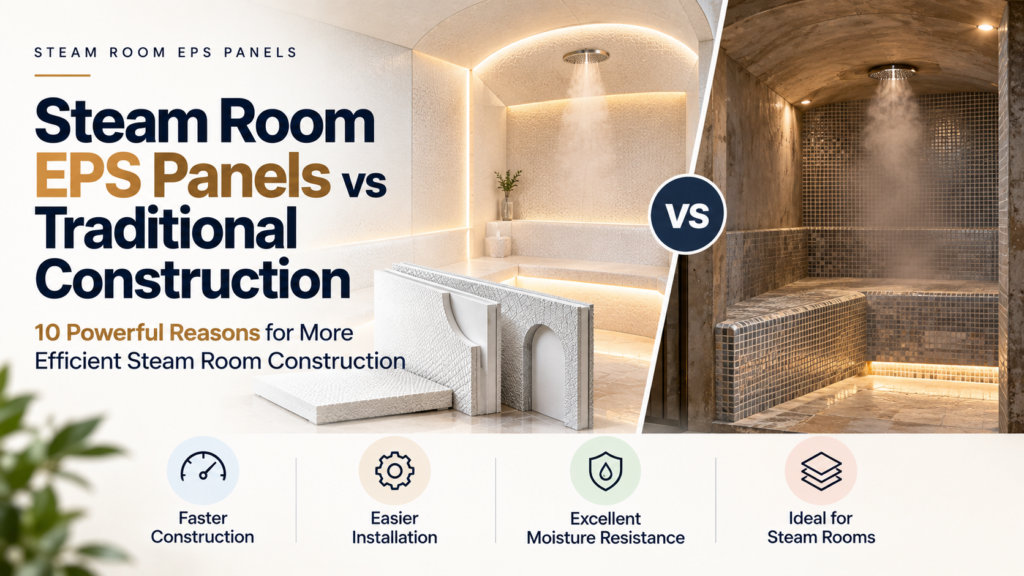
| Factor | EPS Panel Construction | Traditional Construction |
|---|---|---|
| Weight | Lightweight | Generally heavier |
| Fabrication | Can be CNC-cut | Often fabricated on site |
| Installation | Designed for relatively quick assembly | Multiple construction stages |
| Insulation | Integrated into panel system | Usually installed separately |
| Custom Shapes | Highly adaptable with CNC machining | More labor-intensive |
| Material Handling | Easier to move | Can require heavier handling |
| Construction Waste | Can be reduced through precise fabrication | More site cutting and offcuts may occur |
| Design Changes | Digital fabrication can support customization | Changes may require additional site work |
| Waterproofing | Requires a compatible waterproofing system | Requires a compatible waterproofing system |
| Best Use | Custom insulated wellness construction | Conventional structural assemblies |
The actual performance of either method depends on the complete system, installation quality, specifications, and environmental conditions.
One of the biggest differences between EPS and traditional construction is the number of steps involved.
With conventional steam room construction, contractors may need to build the structural shell, install insulation, fix boards, create benches, prepare surfaces, waterproof the assembly, and then apply the final finish.
A CNC-fabricated panel system can simplify several of these steps because components can be manufactured according to the project drawings before arriving at the site.
For example, a custom panel package may include:
The components can then be assembled according to the planned design.
This does not mean every EPS project will automatically be faster. Site conditions, project size, waterproofing requirements, finishing materials, and contractor experience all influence the final timeline.
The main efficiency comes from shifting more work from unpredictable site fabrication to controlled manufacturing.
Thermal performance is central to every steam room.
The objective is to maintain the required internal temperature while limiting unnecessary heat transfer to surrounding areas.
EPS panels for steam rooms provide an insulated core that can help reduce heat transfer through the room enclosure. EPS Industry Alliance documentation identifies EPS as a construction insulation material with stable thermal performance and applications across walls, floors, and ceilings.
Traditional construction can also provide excellent insulation, but insulation is normally treated as a separate component within the wall or ceiling assembly.
With a properly designed EPS system, the insulation is incorporated directly into the panel.
This can simplify the overall assembly and reduce the number of separate components required.
For a commercial wellness facility operating multiple steam cycles every day, thermal efficiency can influence energy consumption and equipment workload. However, actual energy savings depend on the complete room design, steam generator, operating schedule, room volume, insulation thickness, ambient conditions, and other factors.
Traditional construction materials such as concrete blocks, cement boards, mortar, and other masonry components can add considerable weight.
EPS is significantly lighter than many conventional construction materials.
This makes EPS components easier to transport around a project site and can simplify handling during installation.
The lightweight nature of EPS becomes particularly useful when constructing:
Less weight does not mean that the finished room should be treated as structurally independent without engineering review. Load requirements, substrate conditions, fixing methods, reinforcement, and finishing materials must still be evaluated by the project team.
Traditional construction is highly capable, but unusual shapes can require significant site labor.
Curved benches, arches, domes, recessed niches, rounded corners, and customized ceilings may require formwork, multiple board layers, cutting, framing, or manual shaping.
This is where EPS becomes particularly useful.
EPS can be shaped into complex geometries before installation. With digital manufacturing, designers can create components that correspond to the project’s drawings.
For wellness environments where appearance is important, this can open up more possibilities.
Instead of limiting the design to simple rectangular geometry, architects and contractors can explore:
The result is not simply faster construction. It can also create a closer relationship between architectural design and fabrication.
The use of CNC steam room panels takes customization further.
CNC, or Computer Numerical Control, allows a digital design to guide the cutting process. Instead of measuring and cutting every component manually on site, the manufacturer can produce components according to defined dimensions.
This can be particularly useful for projects where multiple pieces need to connect accurately.
For example, a curved bench may need to meet a wall, a niche may need to align with a lighting location, and a ceiling may need to accommodate a particular room shape.
CNC cut steam room panels can be manufactured to these requirements before delivery.
Precision manufacturing can also improve repeatability. If several similar components are required, digital production allows the manufacturer to reproduce the specified geometry consistently.
ThermaCraft Wellness uses advanced CNC technology to manufacture customized EPS components for wellness projects, including thermal cabins and other specialized applications.
This is one of the most important points in the entire comparison.
Neither EPS nor traditional construction should be considered waterproof simply because the material itself has moisture-resistant characteristics.
A steam room contains both liquid water and water vapor. The complete construction assembly must therefore be designed to manage both.
Commercial steam environments can be especially demanding because they may be used frequently, giving the structure less time to dry between operating cycles.
This is why EPS steam room panels must be used as part of a properly specified system.
Depending on the design, the assembly may require:
Schluter’s technical guidance specifically distinguishes waterproofing from vapor management and explains that steam-room assemblies require attention to vapor permeance, particularly in continuous-use commercial applications.
The same principle applies to traditional construction. A masonry or framed wall still needs an appropriate waterproofing and vapor-management strategy.
Therefore, the construction material is only one part of steam room performance.
Labor is another area where EPS systems can influence project efficiency.
Traditional construction usually requires different trades to complete different layers of the room. Masonry, framing, insulation, board installation, waterproofing, and finishing may all happen at separate stages.
CNC-manufactured EPS components can arrive already shaped according to the approved design.
This reduces the amount of measuring and shaping required at the installation site.
CNC steam room panels can therefore be particularly useful for projects where construction time is limited or where the design contains multiple custom components.
However, skilled installation remains essential. A precisely manufactured panel cannot compensate for poor joint treatment, incorrect waterproofing, inadequate substrate preparation, or improper finishing.
The most efficient results come from combining accurate manufacturing with experienced installation.
Traditional construction frequently involves cutting materials on site.
When a contractor cuts cement board, insulation, timber, or other materials, leftover pieces may become waste. Complex shapes can increase this problem.
Digital fabrication can help reduce unnecessary cutting because the required geometry is determined before production.
CNC cut steam room panels can be produced according to specific dimensions, allowing the manufacturer to plan the cutting process more efficiently.
The EPS Industry Alliance also notes that EPS manufacturing can be designed around specific applications and that manufacturing processes can reprocess certain cut-off material.
Waste reduction depends on the manufacturing process and project design, so it should not be assumed that every CNC project produces zero waste.
Still, moving precision cutting from the construction site to a controlled manufacturing environment can improve material planning.
A steam room must continue performing after construction is complete.
The important factors include:
Custom EPS panels for steam rooms can support long-term performance when they are correctly designed and incorporated into an appropriate complete system.
EPS itself is valued in construction for properties including dimensional stability, compressive strength, and thermal resistance.
However, long-term durability cannot be attributed to the EPS core alone.
For example, a poorly sealed penetration can create a moisture problem regardless of how good the insulation is. Similarly, incorrect waterproofing can cause damage behind a tile finish even when the underlying panel is properly manufactured.
That is why the design and installation process is just as important as the panel material.
There is no single construction method that is automatically suitable for every steam room.
Traditional construction may make sense when a project already has an established masonry or framing workflow, straightforward geometry, and readily available labor.
EPS panel construction can be particularly useful when the project requires:
The decision should therefore be based on the complete project rather than the price of one material.
For a simple rectangular steam room, both approaches may be technically feasible. For a highly customized wellness facility with curved benches, unusual ceilings, integrated niches, and tight construction schedules, the advantages of precision-fabricated EPS become more relevant.
ThermaCraft Wellness specializes in customized EPS manufacturing and wellness construction solutions. Its website describes high-density EPS panel production using advanced 5-axis CNC machining and customized production drawings for individual projects.
For projects requiring integrated wellness construction, ThermaCraft also provides supply solutions covering steam rooms, hammams, sauna rooms, thermal cabins, and related wellness systems.
When planning a project, the design team can evaluate the room dimensions, required finish, panel thickness, density, ceiling geometry, bench design, service penetrations, waterproofing system, and installation requirements before manufacturing begins.
You can explore [ThermaCraft Wellness’s wellness solutions] ThermaCraft Wellness for more information about its EPS manufacturing and wellness applications.
For additional information on precision CNC fabrication, see [ThermaCraft’s guide to CNC cutting benefits] 7 CNC Cutting Benefits.
EPS can be used as part of a properly designed steam room construction system. The suitability depends on the complete assembly, including the panel specification, waterproofing, vapor management, joints, substrate, reinforcement, and finish.
EPS provides thermal insulation, while conventional masonry generally requires a separate insulation strategy. The actual thermal performance depends on the thickness, density, construction assembly, joints, and surrounding conditions.
CNC steam room panels are EPS components shaped using computer-controlled cutting equipment. They can be manufactured to specific dimensions and geometries for walls, ceilings, benches, niches, and other custom components.
Yes. One of the major advantages of CNC fabrication is the ability to produce curved and complex shapes. The exact geometry depends on the manufacturing equipment, material specifications, engineering requirements, and project drawings.
No. EPS panels should not be considered a substitute for a properly specified waterproofing and vapor-management system. Steam rooms require careful treatment of joints, corners, penetrations, walls, ceilings, and floors.
They can be particularly useful for commercial projects with complex designs, repeated components, strict construction schedules, or multiple custom shapes. The final choice should be based on project requirements and engineering specifications.
The comparison between steam room EPS panels and traditional construction is ultimately a comparison between different construction approaches.
Traditional construction remains a practical option for many projects, particularly where conventional materials and established construction methods are readily available. EPS-based construction, on the other hand, can simplify insulated construction by combining lightweight components with precision fabrication and customizable geometry.
The biggest advantages appear when a project requires thermal insulation, customized shapes, accurate fabrication, reduced on-site cutting, and efficient installation.
For modern wellness facilities, the goal should not simply be to select the lightest or fastest material. The entire assembly needs to work together—from the structural substrate and insulation to waterproofing, vapor control, finishing, drainage, and ventilation.
When properly designed and installed, EPS technology can provide a practical approach to modern steam room construction, particularly for projects where precision and customization are important.
ThermaCraft’s website describes its custom EPS manufacturing, CNC production, consultancy, design, supply, and installation capabilities.
For the section discussing EPS properties, add a normal DoFollow external link in WordPress to the [EPS Industry Alliance building and construction resource] EPS Industry Alliance – Building & Construction. For the waterproofing/vapor-management section, the [Schluter commercial steam shower guidance] Schluter Commercial Steam Shower Guidance is another relevant technical resource.