
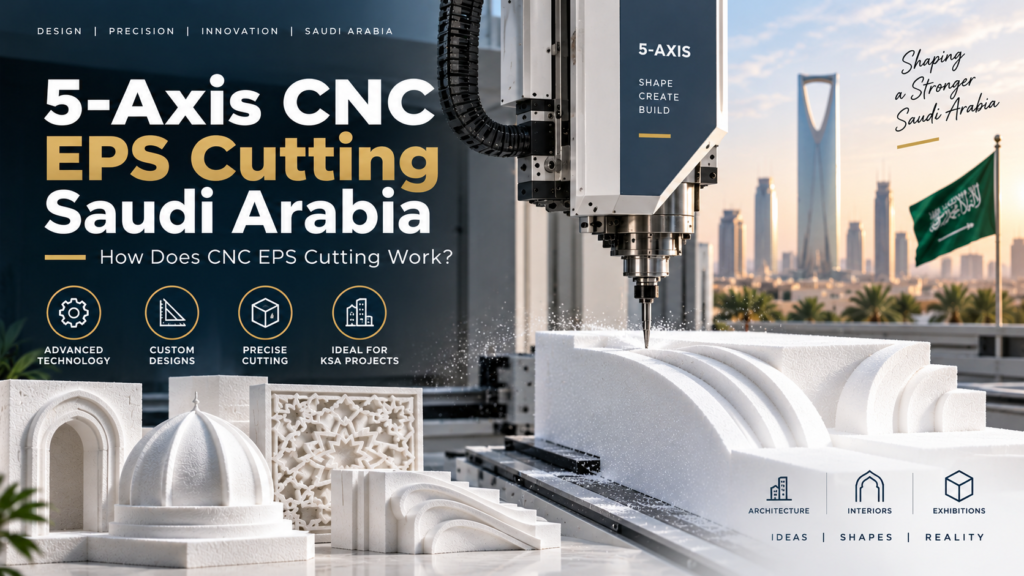
When EPS needs to be shaped into precise curves, angles, profiles, or three-dimensional forms, the cutting method makes a significant difference. Manual cutting can work for simple shapes, but more complex designs require greater control and consistency. This is where 5-Axis CNC EPS Cutting Saudi Arabia becomes useful.
CNC, or Computer Numerical Control, allows EPS material to be cut according to a digital design. A 5-axis CNC system adds further movement and flexibility, allowing the cutting tool to approach the material from different directions. This makes it possible to manufacture customized EPS components for applications such as thermal cabins, steam rooms, hammams, saunas, architectural elements, and other specialized projects.
For businesses looking for customized EPS manufacturing, understanding 5-Axis CNC EPS Cutting Saudi Arabia starts with understanding how CNC EPS cutting actually works, what equipment is involved, and where the technology can be applied.
This guide explains the complete process in simple terms.
CNC EPS cutting is a computer-controlled process used to cut and shape Expanded Polystyrene (EPS) according to a programmed design.
Instead of manually measuring and cutting every part, the required dimensions and shape are created digitally. The CNC machine then follows programmed instructions to produce the required form.
Depending on the machine and cutting system, CNC EPS cutting can be used to create:
The main advantage is control. Once the digital design and machine settings have been prepared correctly, the same design can be reproduced with consistent instructions.
For customized manufacturing, this makes CNC EPS cutting different from basic manual foam cutting.
EPS stands for Expanded Polystyrene. It is a lightweight cellular material that can be manufactured into blocks, sheets, panels, and customized shapes.
EPS is commonly associated with insulation and lightweight construction applications. It can also be machined into customized forms, making it suitable for CNC-based manufacturing.
The properties of the EPS selected for a project can vary depending on the intended application. Density, dimensions, structural requirements, and the final surface treatment should all be considered before production.
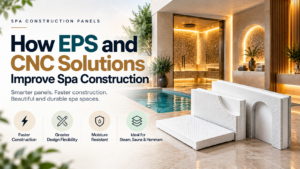
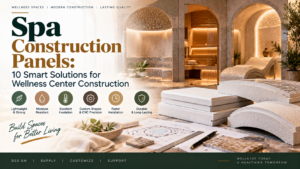
In specialized wellness construction, EPS can be used to manufacture components for thermal cabins and customized spaces.
ThermaCraft Wellness, for example, describes its business as specializing in high-quality EPS panels produced using advanced 5-axis CNC machining technology, with customized products available in different shapes and designs.
The basic CNC EPS cutting process can be divided into several stages. Each stage affects the accuracy and quality of the finished component.
The process begins with a drawing or digital model.
Depending on the project, the design may contain exact dimensions, curves, angles, holes, profiles, or three-dimensional surfaces.
For complicated projects, a 3D model can provide the CNC operator with the information needed to understand the complete geometry of the component.
Accurate drawings are important because the CNC machine follows the information provided through its programming. Incorrect dimensions in the design can result in incorrect components.
Once the design is established, the appropriate EPS material needs to be selected.
The manufacturer considers factors such as:
Material selection should be based on the actual application rather than simply choosing an EPS product based on appearance or cost.
For thermal cabin projects, the EPS specification can be particularly important because the finished panel may later receive additional finishes.
ThermaCraft’s catalogue states that its EPS production includes 42–45 density and fire-rated EPS panels and that its panels can hold up to 50 kg/m² of tile or marble finishes.
The digital design is then converted into machine instructions.
This is where the CNC system determines the cutting path. The program controls how the cutting tool moves through the EPS material to achieve the required shape.
For simple components, the tool path may be relatively straightforward.
For complex components, the programming process can involve multiple directions and changes in tool orientation.
This is one of the areas where a 5-axis EPS CNC system offers additional flexibility.
Before machining begins, the EPS material needs to be positioned securely on the CNC machine.
Correct positioning is important because the machine is working according to a specific coordinate system.
If the material shifts during cutting, the final dimensions may not correspond with the original design.
The operator therefore needs to ensure that the workpiece is properly positioned and that the machine is ready for the programmed cutting operation.
The machine then begins the programmed cutting process.
The CNC system controls the movement of the cutting tool according to the instructions generated from the digital design.
With a conventional three-axis system, movement is primarily controlled along three linear directions.
A five-axis system provides additional rotational movement, allowing the cutting tool to approach the material at different angles.
This additional movement is particularly useful when producing complicated curves, angled surfaces, and three-dimensional shapes.
This is the basic principle behind 5-Axis CNC EPS Cutting Saudi Arabia for customized EPS manufacturing.
Once the cutting operation is complete, the finished EPS component should be inspected.
The manufacturer can check:
Depending on the application, additional finishing or preparation may be required.
For example, an EPS component used in a thermal cabin may need to be prepared for another material or finishing layer before installation.
Not every EPS project requires five-axis machining.
Simple rectangular panels or straightforward profiles may be manufactured using simpler cutting methods. However, when the design becomes more complicated, five-axis technology can offer additional flexibility.
The cutting tool can approach the EPS from different directions, making it suitable for complicated shapes.
Curved and angled surfaces can be difficult to reproduce accurately through manual cutting. CNC machining provides a controlled way to follow a digital profile.
A 3D CNC foam cutting process can be used for designs that require depth and multiple surfaces rather than only flat profiles.
When a project requires multiple identical components, a programmed CNC process can help reproduce the same design repeatedly.
CNC technology makes it easier to manufacture components based on project-specific digital drawings rather than relying only on standard shapes.
An EPS CNC machine is a computer-controlled machine designed to cut or shape EPS according to programmed instructions.
Different machines can have different working dimensions, cutting systems, software capabilities, and numbers of axes.
A five-axis EPS CNC machine provides additional movement compared with a basic three-axis machine.
When selecting an EPS CNC machine, businesses should consider more than just the number of axes.
Important factors include:
The right machine depends on the type of EPS products being manufactured.
CNC foam cutting and manual foam cutting can both be useful, but they are suited to different types of work.
Manual cutting can be practical for simple shapes, prototypes, or situations where very limited quantities are required.
CNC cutting becomes more useful when a project requires precise, repeatable, or complicated shapes.
Some of the main differences include:
| Feature | Manual Foam Cutting | CNC Foam Cutting |
|---|---|---|
| Design control | Operator dependent | Digitally programmed |
| Complex shapes | More difficult | More suitable |
| Repeatability | Can vary | Program can be reused |
| 3D profiles | Limited depending on tools | Suitable for advanced systems |
| Customization | Possible | Highly programmable |
| Production consistency | Depends on operator | Controlled by machine program |
The best method depends on the requirements of the individual project.
CNC EPS fabrication involves more than simply cutting a block of foam.
A complete project can involve design, material selection, CNC programming, cutting, inspection, finishing, and installation.
This approach can be particularly useful when EPS is being manufactured for a specific architectural or construction application.
For example, a thermal cabin may require panels with customized dimensions and shapes rather than standard flat sheets.
The catalogue of ThermaCraft Wellness identifies customized EPS panel solutions as one of its capabilities and connects these panels with thermal cabin production.
Its thermal cabin portfolio includes steam rooms, hammams, saunas, Rasul rooms, tepidariums, scrub rooms, heated loungers, and heated benches.
The applications of 5-Axis CNC EPS Cutting Saudi Arabia depend on the manufacturing capabilities of the supplier and the requirements of the project.
Some common areas where customized EPS machining can be relevant include:
EPS panels can form part of customized thermal cabin systems where insulation and project-specific shapes are required.
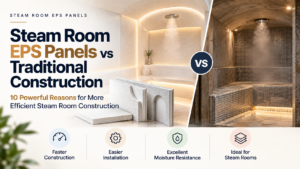
Steam room construction can involve customized surfaces and components. CNC manufacturing can help produce EPS shapes according to a defined design.
Hammam environments often incorporate customized architectural forms. CNC-cut EPS can be used as part of the construction process where suitable.
Customized thermal environments may require project-specific EPS components depending on the construction system being used.
Hotels, resorts, spas, gyms, villas, and premium residential projects can require customized wellness environments.
ThermaCraft identifies luxury resorts and hotels, private villas, gyms and fitness centres, wellness and spa centres, residential buildings, and palaces or premium estates among its target client segments.
One of the more specialized applications of 5-Axis CNC EPS Cutting Saudi Arabia is customized thermal cabin manufacturing.
Thermal cabins may need components that follow the dimensions and geometry of a particular room or architectural design.
Instead of adapting the entire project to standard panel sizes, customized EPS components can be manufactured around the required design.
ThermaCraft describes its EPS thermal cabins as precision-engineered products designed for insulation, durability, and energy efficiency.
This demonstrates how 5-axis EPS CNC technology can be part of a larger manufacturing process rather than simply being a standalone foam-cutting service.
3D CNC foam cutting is useful when the required component has multiple surfaces, curves, slopes, or other three-dimensional characteristics.
The process starts with a 3D digital model. The CNC software then generates the tool paths required to reproduce the model in EPS or another compatible foam material.
This can be useful for:
Five-axis machining can provide additional freedom when the cutting tool needs to change orientation while following a three-dimensional surface.
A successful CNC EPS fabrication project is not determined by the machine alone.
Several factors work together.
The digital drawing should contain the correct dimensions and geometry.
The EPS density and specifications should match the intended application.
The material needs to be positioned properly before machining begins.
The CNC program should be developed according to the geometry and material.
Finished components should be checked before they are sent for installation.
The manufacturer should understand how the component will ultimately be used.
These steps help connect the digital design with the physical product.
If you are searching for 5-Axis CNC EPS Cutting Saudi Arabia for a commercial or construction project, it is useful to evaluate the supplier’s actual manufacturing capabilities.
Ask the supplier:
These questions can help determine whether the supplier can meet the technical requirements of the project.
The main value of 5-Axis CNC EPS Cutting Saudi Arabia is its ability to connect a digital design with a physical EPS component.
Instead of relying entirely on manual shaping, the manufacturer can use a programmed process to reproduce the required geometry.
This is particularly relevant when:
The technology does not replace the need for proper engineering or project planning. Rather, it provides a manufacturing method for turning approved designs into customized EPS components.
5-Axis CNC EPS Cutting Saudi Arabia is a specialized approach to EPS manufacturing that combines digital design, CNC programming, and multi-axis machining.
The process begins with a digital design and suitable EPS material. The design is then converted into CNC instructions, the EPS is positioned on the machine, and the cutting tool follows the programmed path. After machining, the finished component is inspected and prepared for its intended application.
For simple shapes, basic cutting methods may be sufficient. For complex curves, angles, and three-dimensional forms, a 5-axis EPS CNC system can provide greater flexibility.
Applications can include customized EPS panels, thermal cabins, steam rooms, hammams, saunas, wellness spaces, and other specialized projects. CNC foam cutting, CNC EPS fabrication, and 3D CNC foam cutting can all form part of a broader customized manufacturing workflow.
For businesses in Saudi Arabia, choosing the right supplier should involve more than looking at the machine alone. The supplier’s experience with EPS materials, digital designs, CNC fabrication, project requirements, and final applications should all be considered.
For a customized project, the best starting point is to provide accurate drawings or 3D models and discuss the required EPS specifications, dimensions, geometry, quantity, and finishing requirements with the manufacturer. 5-Axis CNC EPS Cutting Saudi Arabia can then be evaluated according to the actual needs of the project rather than as a one-size-fits-all solution.
For customized EPS components and thermal cabin projects, ThermaCraft Wellness provides specialized EPS panel solutions manufactured using advanced 5-axis CNC machining technology. The company offers customized EPS panels in different shapes and designs, along with thermal wellness solutions such as steam rooms, hammams, saunas, Rasul rooms, tepidariums, and scrub rooms. Their approach combines precision EPS manufacturing with customized wellness construction to meet specific project requirements. Explore ThermaCraft Wellness’s EPS panels and thermal cabin solutions to learn more about their products and capabilities.
For a deeper understanding of Expanded Polystyrene (EPS), its properties, and its applications in construction, the EPS Industry Alliance provides useful technical resources covering EPS building systems, insulation, performance properties, and other applications. Their building and construction resources explain how EPS can provide design flexibility, thermal performance, and durability in different construction applications. Learn more about EPS building and construction applications