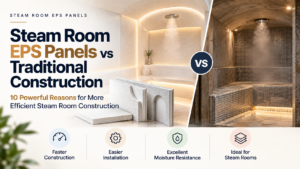

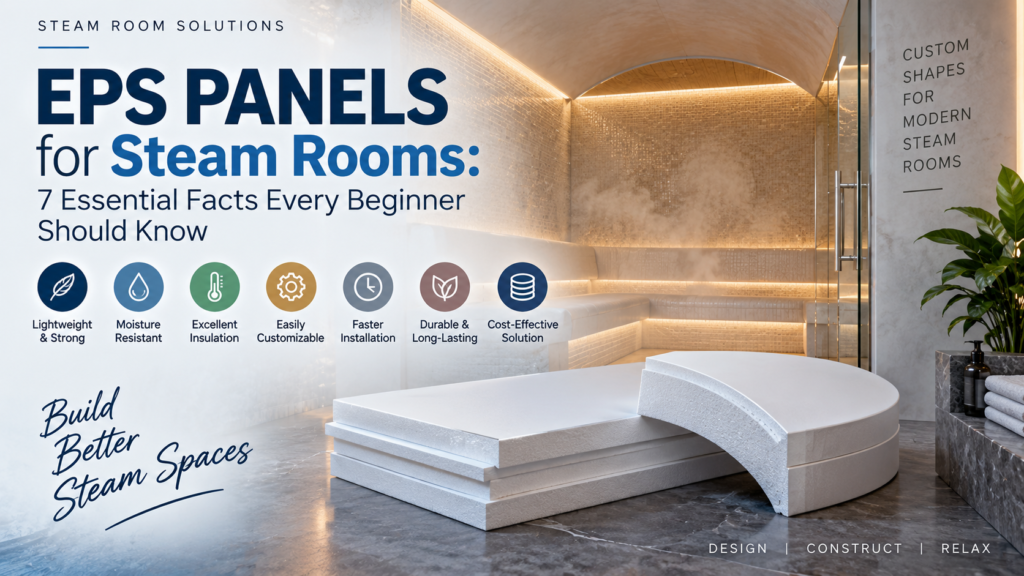
Building a steam room involves much more than installing a steam generator inside a tiled room. The walls, ceiling, benches, insulation, waterproofing, vapor control, and finishing system all have to work together. This is why choosing the right construction system is an important part of the project.
EPS panels for steam rooms are one option used in modern wellness construction to create lightweight, insulated structures that can be shaped around the requirements of a project. When properly designed and combined with the appropriate waterproofing, vapor-control, joint-sealing, and finishing systems, they can simplify the construction of steam rooms and custom wellness spaces.
But what exactly are EPS panels? How are they different from ordinary insulation boards? Can they really be used in a steam room? And what role do CNC cutting and custom fabrication play?
This guide explains the basics in simple language so that architects, contractors, hotel developers, spa owners, and first-time buyers can understand the subject before starting a project.
EPS panels for steam rooms are construction panels made using Expanded Polystyrene (EPS) as the core material. EPS is a lightweight cellular material commonly used for thermal insulation and other construction applications. Its low weight, insulation properties, and ability to be shaped make it useful for specialized construction.
In a steam room project, an EPS panel can form part of the wall, ceiling, bench, partition, or other shaped component.
However, there is an important point to understand:
An EPS core by itself is not the complete steam-room waterproofing system.
A steam room needs proper control of water and water vapor. Depending on the panel system, this may involve reinforced facings, waterproof coatings, vapor barriers, sealed joints, membranes, adhesives, and a suitable tile or stone finish.
For example, specialist steam-room systems use building panels together with dedicated vapor-control layers to protect the surrounding construction from water vapor transmission.
Therefore, when comparing EPS panels for steam rooms, don’t look only at the foam core. Look at the complete panel and installation system.
EPS stands for Expanded Polystyrene.
It is a cellular plastic material made from expanded polystyrene beads. The finished material contains a large amount of trapped air, which contributes to its lightweight nature and thermal insulation performance.
EPS is used in many areas of construction because it can provide:
ASTM C578 covers rigid cellular polystyrene thermal insulation products made from EPS and XPS and identifies properties such as thermal resistance, compressive resistance, water absorption, water vapor permeance, dimensional stability, and fire-related performance as relevant considerations.
For steam room projects, these properties become particularly important because the room operates in a hot, humid environment.
Traditional steam room construction can involve masonry, cement boards, multiple framing components, insulation, waterproofing layers, and considerable on-site fabrication.
A panel-based system can simplify some of this work.
EPS panels for steam rooms can be manufactured into specific sizes and shapes before arriving at the project site. This can reduce the amount of cutting and shaping required during installation.
The lightweight nature of EPS is another practical advantage. Large components can be easier to handle than heavy masonry elements, depending on the overall system design.
EPS also provides thermal insulation, which is valuable in a room where maintaining a controlled temperature is part of its purpose. The EPS Industry Alliance notes that EPS insulation is used in building applications because of properties including thermal resistance, compressive strength, and design flexibility.
For a properly designed steam room, the panel is therefore only one part of a larger assembly.
Structural support → EPS panel → joint treatment → waterproof/vapor-control system → adhesive → tile or stone finish
The exact assembly depends on the manufacturer’s specifications, project requirements, local codes, and selected finishing system.
The simplest way to understand EPS steam room panels is to think of them as a lightweight construction component that helps create the shape and insulated envelope of the room.
Imagine a small steam room.
Instead of building every wall and bench entirely from heavy masonry, the required components can be fabricated from engineered panels.
The panels are positioned to create:
The joints are then treated according to the manufacturer’s system.
After that, the appropriate waterproofing and vapor-control measures are installed before the final surface finish is applied.
This approach can be especially useful for projects with unusual shapes.
For example, a spa may require a curved bench rather than a simple rectangular seat. CNC fabrication can produce that curved component before it reaches the installation site.
A steam room is not simply a bathroom with extra heat.
It continuously produces steam, which means the construction assembly has to deal with heat, moisture, condensation, and water vapor.
This makes waterproofing and vapor control extremely important.
Specialist steam-room systems demonstrate this distinction clearly. For example, Schluter specifies a dedicated vapor-retardant membrane for continuous-use steam rooms, while wedi offers building-board systems designed for high-humidity applications with vapor-control properties.
This is why simply asking whether a material is “waterproof” is not enough.
The complete construction assembly matters.
One of the most obvious benefits of EPS is its low weight.
Compared with many traditional construction materials, EPS components are easier to move and handle during installation.
This can be useful when working on:
The actual weight and structural requirements should always be confirmed from the product’s technical data.
Steam rooms need to retain heat efficiently.
The insulation properties of EPS can help reduce heat transfer through the room envelope. ASTM’s specification for rigid cellular polystyrene specifically addresses thermal resistance as one of the relevant performance properties of these materials.
Better insulation can help the steam room reach and maintain its intended operating conditions more efficiently.
However, the final thermal performance depends on the complete wall and ceiling assembly, not simply the presence of EPS.
Another major advantage is design flexibility.
EPS can be cut into different shapes and dimensions, making it useful for custom wellness construction.
Instead of limiting a project to straight walls and simple rectangular benches, designers can create:
This is where CNC steam room panels become particularly useful.
Traditional construction often requires several steps to create a custom shape.
With CNC manufacturing, a digital design can be converted into a physical component with accurate dimensions.
This allows many components to be prepared before installation.
The result can be a more organized construction process with less on-site shaping and adjustment.
Modern wellness projects are increasingly customized.
A luxury hotel may want a distinctive steam room design. A private residence may require a compact room with curved seating. A spa may want multiple rooms with identical dimensions.
EPS panels for steam rooms can be manufactured for these different requirements rather than forcing every project into one standard shape.
When panels arrive already cut according to the project design, installers may spend less time measuring and cutting components on-site.
This can help reduce:
The actual time savings will depend on project size, design complexity, fabrication accuracy, and installation conditions.
EPS isn’t limited to flat wall panels.
A specialized manufacturer can use CNC technology to create custom components for steam rooms, hammams, saunas, and other wellness spaces.
ThermaCraft Wellness, for example, describes its manufacturing operation as using 5-axis CNC machining to produce customized EPS products for wellness applications.
That type of fabrication opens up more possibilities for designers who need custom geometry.
CNC steam room panels are panels or components shaped using Computer Numerical Control (CNC) machinery.
Instead of manually cutting every piece, the machine follows digital dimensions or a programmed design.
This allows manufacturers to create highly consistent components.
The biggest advantage is not simply that a CNC machine “cuts foam.”
It is the ability to reproduce a planned geometry accurately and consistently.
This becomes particularly useful when several components need to fit together.
The process generally starts with the project design.
The required dimensions and shapes are prepared digitally.
An appropriate EPS block is selected according to the required density, thickness, and application.
The machine follows the digital geometry and cuts the material into the required shape.
Dimensions and profiles can be checked against the project specifications.
The components can be labeled or organized so that installation is easier on-site.
This approach is particularly valuable for projects involving multiple custom components.
Not every steam room has the same design.
A basic residential steam shower may require relatively simple components, while a luxury hotel spa could include curved benches, large ceiling sections, niches, decorative profiles, and unusual room geometry.
This is where custom EPS panels for steam rooms can provide more flexibility than standard flat boards.
For example, a custom project could require a curved bench with a specific radius.
Instead of building the curve manually on-site, the geometry can be incorporated into the CNC design and manufactured as a shaped component.
The key is accurate measurement.
A CNC machine can reproduce the supplied design, but incorrect project measurements will still produce an incorrect component. Good coordination between the designer, manufacturer, contractor, and installer is therefore essential.
Both panel-based construction and traditional construction methods have their place.
The right choice depends on the project’s design, budget, schedule, structural requirements, available labor, and finishing system.
| Factor | EPS Panel System | Traditional Construction |
|---|---|---|
| Weight | Generally lightweight | Usually heavier |
| Custom shaping | Highly flexible | Often requires more on-site work |
| CNC fabrication | Available | Limited |
| Thermal insulation | Can be integrated into system | Often requires separate insulation |
| Installation | Can be faster depending on system | May involve multiple construction stages |
| Custom benches | Can be CNC-shaped | Usually built manually |
| Material handling | Easier for lightweight components | Often more labor-intensive |
| Design flexibility | High | Depends on construction method |
This does not mean EPS is automatically better for every project.
The important question is whether the complete panel system meets the technical requirements of the steam room.
The installation process varies depending on the specific product.
A typical project may follow this sequence:
The floor and supporting surfaces are checked for level, alignment, and structural suitability.
Wall, ceiling, and shaped components are placed according to the approved design.
Appropriate mechanical fasteners, adhesives, or other approved fixing methods are used according to the manufacturer’s instructions.
Panel joints and transitions are sealed using the specified system.
This is one of the most important stages.
The system must address both liquid water and water vapor. Specialist steam-room products use dedicated vapor-control systems for this purpose.
Tile, mosaic, stone, or another approved finish can then be installed according to the system requirements.
The exact installation method should always follow the manufacturer’s technical documentation rather than a generic procedure.
Before purchasing EPS steam room panels, don’t choose based only on price or thickness.
Ask the supplier for technical information.
1. EPS density
Different applications can require different material densities.
2. Panel thickness
Thickness affects insulation and structural characteristics.
3. Facing or coating system
Find out what protects the EPS core and what finishing system is compatible with it.
4. Water resistance
Understand how the complete system handles moisture.
5. Vapor control
This is especially important in continuous-use steam rooms.
6. Fire performance
EPS products and assemblies may be subject to fire-performance requirements and local building regulations. ASTM notes that applicable building codes may regulate fire performance for cellular polystyrene insulation.
7. Load requirements
Benches and other components must be designed for their intended loads.
8. CNC accuracy
For custom components, ask how dimensions are controlled and inspected.
9. Installation method
A good panel can still perform poorly if it is installed incorrectly.
10. Technical support
A reliable manufacturer should be able to provide drawings, specifications, installation guidance, and project-specific recommendations where required.
The answer depends on the specific EPS panel system and complete construction assembly, rather than the word “EPS” alone.
Saudi projects can include private villas, hotels, spas, gyms, wellness centers, and large hospitality developments. These projects may require different levels of performance, customization, and regulatory compliance.
For steam room EPS panels Saudi Arabia projects, buyers should therefore evaluate:
The Saudi Building Code includes requirements related to building materials and thermal- and sound-insulating materials, so project teams should verify the applicable provisions for their particular building and use.
For a Saudi wellness project, working with a manufacturer capable of producing custom CNC cut steam room panels can also simplify projects with unusual dimensions or architectural shapes.
They can be used as part of a properly engineered steam-room construction system. However, the EPS core alone should not be treated as the complete waterproofing or vapor-control solution. The full assembly, including joints, membranes, coatings, and finishes, must be suitable for the intended application.
EPS panels for steam rooms can be used to create insulated wall, ceiling, bench, partition, and custom-shaped components. Their exact use depends on the manufacturer’s system and project requirements.
Both are polystyrene insulation materials, but EPS is expanded polystyrene while XPS is extruded polystyrene. Their manufacturing processes and physical properties differ, so they should not be treated as interchangeable without checking the technical specifications. ASTM C578 covers both EPS and XPS insulation products.
CNC cut steam room panels are panels or components shaped using computer-controlled machinery. CNC fabrication allows manufacturers to produce accurate dimensions and custom curves, profiles, benches, and other shapes.
Yes, appropriately engineered EPS components can be CNC-shaped into curved benches and other architectural forms. The final design must account for structural support, loading, finishing, waterproofing, and the manufacturer’s specifications.
A steam room requires an appropriate waterproofing and vapor-control strategy. Whether a particular panel has an integrated waterproof layer or requires additional treatment depends on the product system. Always follow the manufacturer’s installation requirements.
Yes. Lightweight construction is one of the key characteristics of EPS. This can make handling and installation easier compared with heavier construction materials, although the complete finished assembly will weigh more than the EPS core itself.
Yes. Custom EPS panels for steam rooms can be manufactured according to project dimensions and design requirements. CNC fabrication is particularly useful when the project contains curves, arches, niches, or other non-standard shapes.
EPS panels for steam rooms provide a practical approach to creating lightweight, insulated, and customizable wellness structures. Their value comes from more than the EPS material itself. The real performance depends on how the panels are engineered, shaped, joined, waterproofed, vapor-controlled, supported, and finished.
For straightforward projects, standard panels may be sufficient. For more complex wellness spaces, CNC steam room panels and custom EPS panels for steam rooms can provide greater freedom in creating curved benches, arches, niches, domes, and other architectural features.
For projects in Saudi Arabia, selecting steam room EPS panels Saudi Arabia suppliers should involve more than comparing prices. Buyers should review technical specifications, density, thickness, fire performance, moisture and vapor-control requirements, finishing compatibility, installation guidance, and compliance with applicable project requirements.
When these factors are considered from the beginning, EPS panel technology can become a useful part of an efficient and highly customized steam room construction process.
If you’re adding internal links, a natural paragraph would be:
Modern wellness projects often require more than standard construction materials. From steam room construction and Moroccan hammams to custom thermal cabins and CNC-shaped wellness components, choosing the right construction system can simplify installation while supporting the project’s design requirements. Explore ThermaCraft Wellness’s range of EPS panels, CNC-cut wellness solutions, steam rooms, hammams, and custom thermal structures to learn more about modern wellness construction.
When choosing EPS panels for steam rooms, it is important to look beyond panel thickness and insulation value. Factors such as thermal resistance, compressive strength, water absorption, water-vapor permeance, dimensional stability, and fire-related performance can all be relevant when evaluating cellular polystyrene insulation. ASTM C578-23 provides specifications covering the physical properties and dimensions of cellular polystyrene insulation products. ASTM C578-23 – Rigid, Cellular Polystyrene Thermal Insulation For projects in Saudi Arabia, the applicable requirements of the Saudi Building Code should also be reviewed during the design and construction process to ensure that the selected materials and assemblies meet the requirements relevant to the project.