
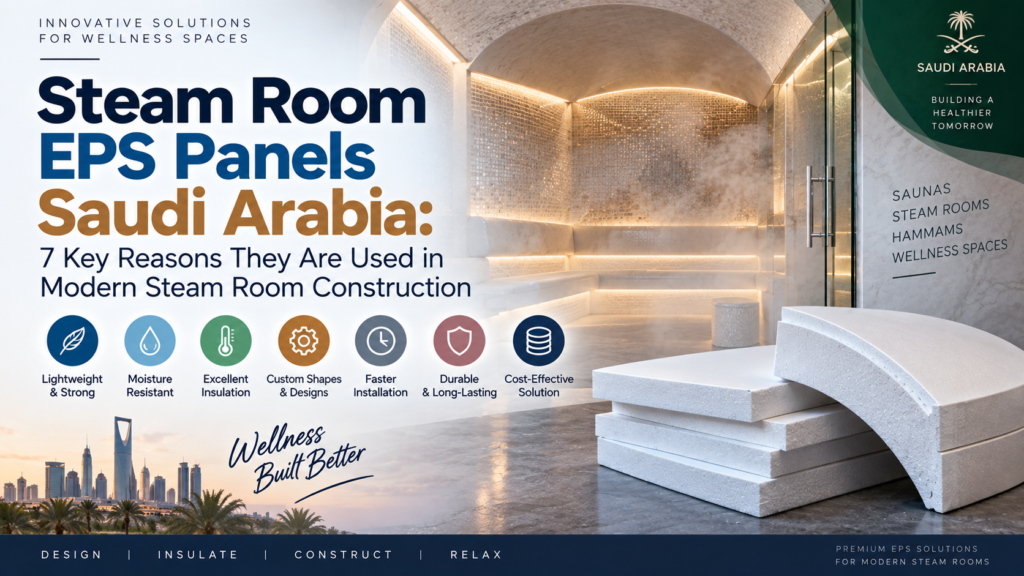
Steam rooms are designed to handle a combination of heat, humidity, water, and continuous exposure to steam. Because of this, the materials used to build them need to be selected carefully. The wall and ceiling system is especially important because it affects insulation, moisture management, installation, and the final design.
This is where steam room EPS panels Saudi Arabia projects can benefit from specialized panel-based construction systems.
EPS, or Expanded Polystyrene, is a lightweight cellular material used in insulation and construction. Its thermal performance, low weight, dimensional stability, and ability to be shaped make it suitable for a range of building applications. ASTM C578 covers cellular polystyrene insulation and addresses properties including thermal resistance, compressive resistance, water absorption, water-vapor permeance, dimensional stability, and fire-related requirements.
But why are EPS panels considered for steam rooms in the first place?
The answer is not simply that EPS is lightweight. A well-designed steam room panel system can help address several practical construction requirements at the same time, particularly when the panels are manufactured for specific room dimensions and combined with an appropriate waterproofing and vapor-control system.
This guide explains why EPS panels are used in steam room construction, how they work, where CNC cutting fits into the process, and what buyers should consider before selecting a panel system.
Steam room EPS panels Saudi Arabia suppliers provide are generally based on panels or shaped components made with an Expanded Polystyrene core and, depending on the system, additional facings, coatings, reinforcement, or surface treatments.
EPS is a cellular plastic material. The EPS Industry Alliance describes it as a lightweight material used in building and construction, with properties including thermal resistance, compressive strength, and dimensional stability.
In a steam room, these panels can be used to create or support different parts of the room, such as:
However, an EPS panel should not automatically be considered a complete waterproofing system.
A steam room needs an appropriate approach to waterproofing and vapor management. For example, specialist steam-room membranes are specifically designed to control water and water vapor in high-humidity environments. Schluter’s KERDI-DS is one example of a membrane marketed for continuous-use steam rooms and similar applications.
Therefore, when evaluating steam room EPS panels Saudi Arabia projects, it is important to evaluate the complete wall or ceiling assembly, not only the EPS core.
There are several reasons contractors, designers, and wellness-project developers may consider EPS panel systems.
The biggest advantages are related to insulation, weight, shaping, fabrication, and installation.
Let’s look at each one.
One of the primary reasons EPS is used in construction is its thermal insulation capability.
A steam room needs to create and maintain a controlled hot and humid environment. If heat transfers too easily through the walls and ceiling, the room may require more energy to maintain the desired conditions.
EPS contains a large amount of trapped air within its cellular structure, which contributes to its insulating characteristics. EPS Industry Alliance identifies thermal resistance as one of the material’s important performance properties.
ASTM C578 also identifies thermal resistance as one of the properties used when specifying cellular polystyrene insulation.
This makes insulation an important consideration when designing steam room EPS panels Saudi Arabia projects.
Good insulation can help:
The actual performance depends on the complete assembly, including panel thickness, density, joints, coatings, finishes, and surrounding construction.
Another important advantage of EPS is its low weight.
Traditional steam room construction may involve masonry, cement-based materials, metal framing, boards, insulation, waterproofing layers, and other components. Depending on the design, these assemblies can become relatively heavy.
EPS-based components can reduce the weight of certain parts of the construction.
This can make them easier to:
This can be especially useful when working on hotel rooms, spas, villas, or renovation projects where access may be restricted.
The EPS Industry Alliance identifies EPS as a lightweight construction material and highlights its combination of physical and mechanical properties.
For steam room EPS panels Saudi Arabia projects, lightweight components can also be useful when multiple custom pieces need to be transported and installed.
Steam room construction can become complicated when every component has to be built and shaped on-site.
A panel-based approach can move some of the work from the construction site to the manufacturing facility.
Instead of receiving raw materials and creating every shape manually, a project can use panels manufactured according to predetermined dimensions.
The process can involve:
This does not mean every EPS project will automatically be faster.
Installation time depends on the design, number of components, site conditions, installer experience, and finishing system.
However, EPS panels for steam rooms can reduce some of the repetitive fabrication work that would otherwise take place on-site.
A major advantage of EPS is its ability to be shaped.
Steam rooms do not always have simple rectangular designs.
A luxury spa might require:
Creating these shapes using conventional construction methods can require multiple materials and considerable on-site fabrication.
EPS can be shaped before installation, making it useful for customized designs.
This is particularly relevant to custom EPS panels for steam rooms, where the manufacturer produces components according to the project’s dimensions and geometry.
Imagine a steam room with a curved seating bench.
With conventional construction, the curve may need to be created manually using several construction stages.
With a custom EPS component, the curve can be incorporated into the digital design and fabricated before the component reaches the site.
This can make the construction process more predictable.
This is where CNC steam room panels become particularly useful.
CNC stands for Computer Numerical Control.
Instead of manually cutting a panel with basic tools, a CNC machine follows a digital design to produce the required shape.
For complex steam room projects, CNC fabrication can be used to create:
The major advantage is repeatability.
If several components need to follow the same profile, CNC manufacturing can help maintain consistency between them.
A simplified process looks like this:
Digital design → CNC programming → EPS block preparation → CNC cutting → Quality checking → Delivery → Installation
This is one reason CNC cut steam room panels can be valuable for projects where accuracy and customization are important.
Steam rooms need more than four walls.
Many projects include built-in seating, niches for accessories, lighting features, steps, shelves, or decorative elements.
Building these components manually can increase the number of construction stages.
With specialized EPS steam room panels, some of these elements can be manufactured as shaped components.
| Component | Possible EPS Application |
|---|---|
| Steam room wall | Flat panel |
| Ceiling | Insulated panel |
| Bench | Shaped EPS component |
| Curved bench | CNC-cut component |
| Niche | Custom-cut section |
| Arch | CNC-shaped profile |
| Partition | Panel assembly |
| Decorative feature | Custom EPS shape |
The final component still needs to meet the project’s structural, finishing, waterproofing, and vapor-management requirements.
EPS provides the shape and insulation; the complete assembly determines how the finished element performs.
Another reason steam room EPS panels Saudi Arabia projects may use custom-fabricated components is to reduce unnecessary cutting and shaping at the construction site.
On-site fabrication can create several challenges.
Workers may need to:
When components are manufactured in advance, much of this work can be completed under controlled manufacturing conditions.
This can potentially reduce material waste and make installation more organized.
It also allows the project team to identify dimensional problems earlier in the process.
This is one of the most important questions to understand.
Steam rooms are exposed to high levels of humidity and water vapor. Therefore, simply choosing an insulating panel is not enough.
The waterproofing and vapor-control system must be appropriate for the intended use.
For example, Schluter states that continuous-use steam rooms require specialized vapor management and offers KERDI-DS as a waterproofing membrane and vapor retarder designed for these conditions.
That means the construction should be considered as a complete system.
EPS panel → joint treatment → waterproofing/vapor-control layer → adhesive → tile or stone finish
The actual sequence and materials vary by manufacturer.
This is why buyers should always request the manufacturer’s technical documentation before specifying EPS panels for steam rooms.
Both methods can be used for steam room projects, but they approach construction differently.
| Feature | EPS Panel Approach | Traditional Construction |
|---|---|---|
| Weight | Generally lightweight | Often heavier |
| Shaping | Easy to fabricate into custom profiles | Usually more on-site work |
| CNC fabrication | Possible | Generally limited |
| Insulation | Can form part of the panel system | Often installed separately |
| Custom benches | Can be factory-shaped | Often constructed manually |
| Installation | Potentially streamlined | Multiple construction stages |
| Design flexibility | High for custom shapes | Depends on construction method |
| Site cutting | Can be reduced | Often greater |
This table should not be interpreted as saying EPS is automatically the correct material for every project.
The appropriate choice depends on the design, structural requirements, moisture-control strategy, local regulations, budget, and manufacturer’s specifications.
Saudi Arabia has a growing market for hotels, resorts, spas, fitness centers, private residences, and wellness facilities.
These projects can involve both standard and highly customized steam rooms.
For steam room EPS panels Saudi Arabia applications, customization can be particularly useful when the project has:
Climate and building requirements should also be considered during material selection.
The Saudi Building Code includes provisions related to thermal insulation and other building systems, so project teams should verify the requirements applicable to their specific project rather than relying on a generic material specification.
A professional supplier should be able to provide relevant technical information about the EPS density, thickness, performance, fabrication method, and installation requirements.
Before selecting EPS panels for steam rooms, ask the supplier some basic but important questions.
Density can affect the physical and mechanical properties of EPS.
Thickness can influence thermal performance and the overall construction assembly.
Find out what material protects the EPS and what finishes are compatible with it.
This is particularly important in a steam room.
Do not assume that an EPS core alone provides the required vapor-control performance.
The panel manufacturer should specify compatible waterproofing products and installation methods.
For custom designs, CNC fabrication can make a major difference.
Ask whether the manufacturer can produce:
ASTM notes that cellular polystyrene insulation products can be subject to building-code requirements relating to fire performance.
The applicable requirements should therefore be checked for the project.
For complex projects, drawings and fabrication details are important.
This matters when working with custom steam room designs.
A good product still requires correct installation.
EPS panels for steam rooms are used because EPS can provide lightweight construction, thermal insulation, and design flexibility. When engineered as part of a complete steam-room system, the panels can also simplify the fabrication of walls, ceilings, benches, and custom architectural features.
EPS itself should not automatically be treated as the complete waterproofing or vapor-control system for a steam room. The finished construction requires an appropriate waterproofing and vapor-management strategy. The exact requirements depend on the panel system and manufacturer.
CNC steam room panels are panels or shaped components manufactured using computer-controlled cutting equipment. CNC technology allows manufacturers to create accurate curves, profiles, benches, niches, and other custom shapes.
They can be particularly useful for custom designs because digital fabrication allows complex shapes to be produced more consistently than manual on-site cutting.
Yes, specially designed EPS components can be used to create bench forms and other architectural elements. However, the finished bench must have appropriate structural support, load capacity, surface treatment, waterproofing, and finishing.
They may be suitable when the complete panel system is specifically designed and approved for the intended application. Commercial steam rooms can experience more frequent use and greater moisture exposure than residential rooms, so vapor management and waterproofing deserve particular attention.
Custom EPS panels for steam rooms allow the manufacturer to produce components according to specific room dimensions and shapes. This can be useful for curved walls, benches, arches, niches, and other non-standard designs.
They can be considered for suitable projects when the selected system meets the project’s technical requirements. For steam room EPS panels Saudi Arabia applications, designers and contractors should evaluate insulation, moisture management, vapor control, fire performance, structural requirements, finishing compatibility, and applicable Saudi regulations.
So, why are EPS panels used in steam room construction?
The answer comes down to a combination of thermal insulation, low weight, design flexibility, easier fabrication, and the ability to create custom components
For straightforward projects, standard panels may be enough. For high-end wellness spaces, CNC steam room panels and custom EPS panels for steam rooms can make it possible to create curved benches, arches, niches, domes, and other architectural details without relying entirely on manual fabrication at the construction site.
However, the EPS core is only one part of the system.
A successful steam room also requires appropriate waterproofing, vapor control, joints, structural support, finishing materials, drainage, and proper installation. Specialist steam-room systems emphasize the importance of managing both liquid water and water vapor, particularly in continuously used commercial environments.
For steam room EPS panels Saudi Arabia projects, the best approach is to evaluate the complete system and its technical documentation rather than selecting a panel based only on price or thickness.
When properly specified and fabricated, EPS panel technology can provide a practical foundation for modern steam rooms while giving designers much greater freedom to create customized wellness spaces.
Modern wellness projects increasingly require construction solutions that combine thermal performance, customization, and efficient fabrication. From steam rooms and hammams to curved benches and other specialized wellness structures, the right panel system can simplify complex designs and reduce unnecessary on-site fabrication. Explore ThermaCraft Wellness’s EPS panel and CNC fabrication solutions to learn more about custom construction options for steam rooms and other wellness environments
When choosing steam room EPS panels Saudi Arabia for a project, it is important to consider factors such as thermal resistance, compressive strength, water absorption, water-vapor performance, dimensional stability, and fire-related properties. These characteristics are covered in ASTM C578, which provides specifications for rigid cellular polystyrene thermal insulation products. ASTM C578-23 – Rigid, Cellular Polystyrene Thermal Insulation For steam room construction, vapor control is also essential because the space is exposed to continuous heat and steam. Schluter KERDI-DS is an example of a specialized waterproofing and vapor-retarding membrane designed for continuous-use steam rooms. Schluter KERDI-DS – Waterproofing and Vapor Retarder Projects in Saudi Arabia should also be checked against the applicable requirements of the Saudi Building Code.
You can add your relevant ThermaCraft Wellness page links to the anchor texts yourself.