
Modern Turkish baths combine traditional hammam design with contemporary construction methods. Curved walls, domed ceilings, heated benches, decorative niches, arches, and moisture-resistant finishes all need to work together to create a functional space.
This is one reason Hammam EPS panels Saudi Arabia are increasingly relevant to modern hammam construction. EPS-based construction systems can be shaped into different forms and used to create the underlying structure for customized Turkish bath interiors. When combined with suitable reinforcement, waterproofing, and finishing systems, they can provide a practical alternative to building every feature using conventional masonry.
For contractors, architects, wellness developers, and property owners, understanding how these panels work is important before selecting a construction method.
In this guide, we will explain why EPS panels for Turkish baths are used, how they can be applied to different parts of a hammam, what role CNC cutting plays, and what should be considered when planning a Turkish bath project in Saudi Arabia.
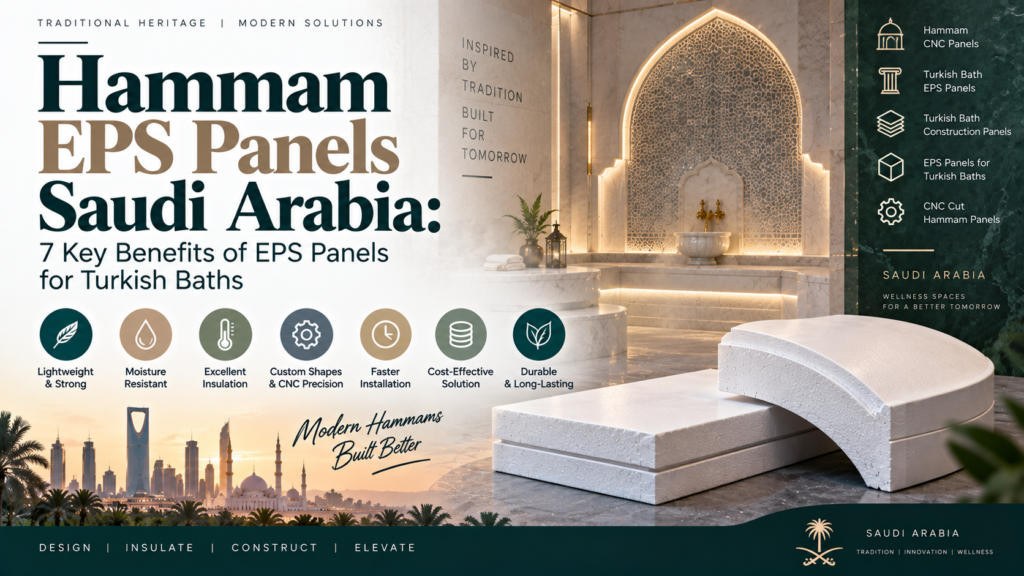
Hammam EPS panels Saudi Arabia are construction components based on expanded polystyrene (EPS) that are designed to help create walls, ceilings, benches, partitions, niches, and other architectural forms in hammam projects.
EPS is a lightweight material that can be cut and shaped into different geometries. This characteristic makes it useful for Turkish baths, where architectural designs often include curves and shapes that can be difficult to construct using only conventional flat materials.
However, an EPS panel should not be viewed as the finished hammam surface.
A complete hammam construction system may involve the EPS component, reinforcement, adhesives or fixing methods, waterproofing, surface preparation, and a final finish such as tile, mosaic, stone, or another specified material.
The exact construction method depends on the panel manufacturer and project requirements.
This is an important distinction when researching Turkish bath EPS panels. The EPS component forms part of a larger construction assembly rather than replacing every other layer of the hammam.
Traditional hammam architecture is known for its distinctive shapes.
A project may include:
Creating these shapes with traditional masonry can involve multiple construction stages. Materials need to be measured, cut, shaped, joined, plastered, and finished on site.
EPS panels for Turkish baths offer another approach. Components can be designed and prepared before installation, particularly when CNC cutting is used.
Instead of treating every curved feature as a separate manual construction challenge, the design can be converted into accurately shaped components.
This makes EPS particularly interesting for customized hammam projects where design flexibility and efficient fabrication are important.
One of the most obvious advantages of EPS is its low weight compared with many traditional construction materials.
Large or curved components can therefore be easier to handle during fabrication and installation.
For a hammam project, this can be useful when constructing features such as:
The lower weight does not mean that every EPS panel can be used for every structural purpose. The panel’s technical specifications and intended application must always be checked.
Still, lightweight construction is one of the main reasons Hammam EPS panels Saudi Arabia can be considered for customized wellness projects.
Traditional Turkish baths often depend on architectural details that are not completely straight or rectangular.
A modern hammam may have a circular bench surrounding a central feature or a ceiling with a curved transition between the walls and dome.
Turkish bath construction panels can be shaped to suit these types of designs.
This gives designers more flexibility when developing customized interiors.
Instead of limiting the design to shapes that are easy to build with standard boards or masonry blocks, the construction system can be planned around the desired geometry.
This is particularly valuable for luxury wellness projects where the interior needs to follow a specific architectural concept.
CNC technology is one of the most useful features associated with modern EPS fabrication.
Hammam CNC panels can be produced from digital designs using computer-controlled cutting equipment.
A digital model can define:
The CNC machine then follows the programmed cutting path.
This can help produce consistent components for a project.
For example, if a hammam requires several identical decorative niches, CNC fabrication can help reproduce the same profile rather than relying on separate manual measurements for every piece.
The result is particularly useful for projects involving detailed or repeated architectural forms.
Curved features are an important part of many Turkish bath designs.
A conventional flat panel has limitations when the design requires a three-dimensional curved form. EPS, on the other hand, can be cut into different profiles.
CNC cut Hammam panels can therefore be used to create the basic shape of features such as:
Once the shape is assembled, the appropriate reinforcement and surface preparation can be completed according to the construction system.
This allows the final decorative material to follow the intended architectural form.
Benches are among the most recognizable elements of a hammam.
A project may require straight seating, curved seating, corner benches, raised platforms, or customized reclining areas.
Constructing every seating shape using conventional masonry can require considerable on-site shaping and finishing.
EPS panels for Turkish baths can be fabricated into the basic geometry required for these features.
For example, a curved bench can be designed digitally and divided into appropriate panel components. These components can then be assembled and prepared for the final surface finish.
The finished bench may eventually be covered with tile, mosaic, stone, or another specified material.
The EPS remains within the construction assembly rather than being the exposed finished surface.
Ceilings can be one of the more complicated areas of Turkish bath construction.
Traditional hammams often feature domes, arches, curved transitions, and decorative ceiling details.
Creating these forms manually can require specialist workmanship.
With Hammam EPS panels Saudi Arabia, curved ceiling sections can be designed and fabricated according to the required geometry.
CNC cutting can be particularly helpful for complex forms.
The construction team can receive components prepared according to the design rather than creating every curve from scratch at the job site.
However, ceiling design must also consider lighting, ventilation, steam distribution, access, moisture management, and the requirements of the final finish.
The architectural shape is only one part of the ceiling system.
Another potential benefit of Turkish bath EPS panels is that customized components can be prepared before reaching the construction site.
This can reduce some of the shaping work that would otherwise be carried out manually during installation.
A typical workflow may look like:
Site measurement → Digital design → CNC fabrication → Component inspection → Site installation → Reinforcement → Waterproofing → Surface finishing
This does not mean that every hammam will automatically be completed faster. Project schedules depend on design complexity, site conditions, workforce, material availability, installation methods, and finishing requirements.
However, preparing customized components in advance can make certain stages of construction more organized.
The applications of Hammam EPS panels Saudi Arabia can vary depending on the project.
EPS components can be used to form wall structures, curved sections, partitions, and customized wall features.
Panels can create the underlying shape of straight or curved seating.
Custom-shaped components can be used to create curved ceilings, domes, arches, and transitions.
CNC fabrication can create recessed wall niches for decorative or functional purposes.
Doorway arches and decorative architectural forms can be produced according to the project’s dimensions.
Raised areas and customized platforms can be formed using appropriate panel systems.
The suitability of each application depends on the technical specifications of the selected product.
The term Hammam CNC panels generally refers to EPS or similar construction components that have been shaped using computer-controlled cutting equipment for hammam applications.
The advantage of CNC technology is repeatability.
Suppose a project needs ten decorative wall elements with the same dimensions. Producing each component manually can introduce small differences.
A digital CNC workflow can help maintain a consistent design across repeated components.
CNC cutting can also be useful for complicated curves and profiles that would take more time to reproduce manually.
For manufacturers and contractors, this makes CNC fabrication an important part of modern customized hammam construction.
The process starts with the project design.
The project dimensions are collected from architectural drawings or site measurements.
The required wall, bench, ceiling, niche, or decorative component is prepared digitally.
The digital geometry is converted into cutting instructions.
The CNC equipment cuts the EPS material according to the programmed shape.
The finished component is checked against the design specifications.
The components are delivered to the project and assembled according to the installation plan.
The panel assembly is reinforced and prepared for the required waterproofing and finishing system.
This process is why CNC cut Hammam panels are particularly useful when a project involves customized geometry.
This is one of the most important questions when considering EPS panels for Turkish baths.
EPS itself should not be treated as a complete waterproofing solution.
A Turkish bath is exposed to steam, condensation, water, cleaning, and high humidity. Therefore, the complete construction assembly needs appropriate moisture and waterproofing detailing.
This can include:
The exact system depends on the manufacturer and project specification.
For this reason, Turkish bath construction panels should always be installed according to the manufacturer’s technical instructions and the requirements of the complete hammam design.
Temperature management is another important part of hammam construction.
A Turkish bath needs to maintain a controlled warm and humid environment. The walls, ceiling, floor, doors, ventilation system, steam generator, and other components all contribute to how the space performs.
EPS is commonly associated with thermal insulation because of its cellular structure. However, the thermal performance of a finished hammam depends on the complete construction assembly rather than the EPS component alone.
Factors such as:
can influence the final performance.
Therefore, technical specifications should be reviewed before selecting Hammam EPS panels Saudi Arabia for a particular project.
When selecting Hammam EPS panels Saudi Arabia, the project location should be considered alongside the design and technical requirements.
Start with the architectural and engineering requirements.
Panel selection should follow the intended application rather than simply choosing the most convenient material.
A hammam is a high-humidity environment. Joints, corners, drains, penetrations, and transitions require careful detailing.
Different EPS products and panel systems have different fire performance characteristics.
The relevant product documentation should be reviewed before specification.
The selected finish can affect the construction system.
Tile, mosaic, stone, plaster, and other materials may have different requirements for substrate preparation and adhesion.
Even a well-designed panel can perform poorly if installation is incorrect.
Following the manufacturer’s installation method is essential.
For custom projects, measurements should be checked carefully before CNC fabrication.
An incorrect dimension in the digital drawing can result in components that do not fit the intended location.
Both EPS-based systems and conventional construction methods can be used for different types of projects.
The difference is primarily in how the structure and architectural forms are created.
| Feature | EPS Panel System | Traditional Construction |
|---|---|---|
| Weight | Generally lightweight | Often heavier |
| Custom shapes | Highly adaptable | Can require more manual work |
| CNC fabrication | Possible | Generally not applicable |
| Curved features | Can be CNC-shaped | Usually built and shaped on site |
| Repeated components | Can be digitally reproduced | Often manually reproduced |
| Installation approach | Panel assembly | Masonry/build-up construction |
| Finishing | Requires appropriate surface system | Depends on substrate |
| Waterproofing | Still required | Still required |
This does not make one construction method universally suitable for every hammam.
The correct choice depends on the project’s architecture, technical requirements, budget, timeline, available workforce, and finishing system.
Before purchasing Turkish bath EPS panels, ask several practical questions.
Confirm whether the product is intended for walls, ceilings, benches, partitions, or another application.
Understand how the surface is strengthened before finishing.
The waterproofing layer should be compatible with the complete construction assembly.
Check whether the system is suitable for the intended tile, mosaic, stone, or other finish.
For customized designs, CNC compatibility can be an important consideration.
A reliable supplier should be able to provide relevant technical information, installation instructions, and product specifications.
These questions are especially important when sourcing Hammam EPS panels Saudi Arabia for a commercial wellness facility, hotel, spa, residential hammam, or large-scale development.
The design expectations for modern wellness facilities are changing.
Today’s hammams may combine traditional architectural elements with contemporary interiors, customized lighting, modern plumbing, digital design, and specialized finishes.
This creates demand for construction systems that can accommodate complex shapes without making every feature difficult to fabricate.
Hammam EPS panels Saudi Arabia can provide this flexibility when the selected system is appropriate for the project.
The combination of EPS and CNC technology is particularly useful.
Hammam CNC panels can transform digital designs into physical components, while CNC cut Hammam panels can help create repeatable curved and decorative forms.
At the same time, the complete construction process still needs to address waterproofing, reinforcement, thermal requirements, drainage, fire considerations, and finishing.
Hammam EPS panels Saudi Arabia are used in modern Turkish bath construction because they can combine lightweight construction with the flexibility required for customized architectural forms.
From curved benches and domed ceilings to arches, niches, partitions, and decorative features, EPS panels for Turkish baths can provide a practical base for creating complex hammam interiors.
The addition of CNC fabrication makes the process even more adaptable. Hammam CNC panels can be shaped from digital designs, allowing manufacturers to produce components with specific dimensions and profiles.
However, the panel itself is only one part of the construction system. Proper reinforcement, waterproofing, surface preparation, drainage, thermal planning, and finishing are essential to the performance of the finished Turkish bath.
For contractors, architects, and wellness developers, the most important step is to evaluate the complete system rather than looking at the EPS component in isolation.
When properly designed and installed, Turkish bath EPS panels and Turkish bath construction panels can help translate traditional hammam architecture into modern construction.
The performance of EPS panels for Turkish baths depends greatly on accurate manufacturing and proper panel specification. CNC technology allows complex components to be produced according to detailed project drawings, including curved benches, dome ceilings, niches, and other customized shapes. To learn more about precision manufacturing and the role of CNC technology, read our guide on EPS Panel Manufacturer Saudi Arabia.
When planning a Turkish bath project in Saudi Arabia, panel selection should be considered alongside applicable construction, safety, and technical requirements. The Saudi Building Code provides the national technical reference for building requirements, specifications, safety, and structural sustainability. The Saudi Standards, Metrology and Quality Organization (SASO) develops and approves Saudi standards and technical regulations for products and services and oversees relevant conformity requirements. Before specifying Hammam EPS panels Saudi Arabia, project teams should review the requirements applicable to their particular project and verify that the selected construction system meets the necessary specifications.