
Modern spa projects demand more than attractive interiors. A successful spa needs construction materials that can work with the requirements of humid environments, temperature-controlled rooms, customized layouts, curved features, and specialized finishes. This becomes even more important when a project includes steam rooms, saunas, hammams, treatment rooms, relaxation areas, and other wellness facilities.
This is where spa construction panels can offer a practical approach to modern construction.
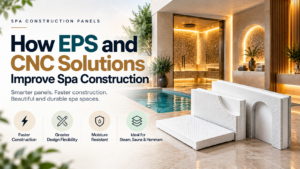
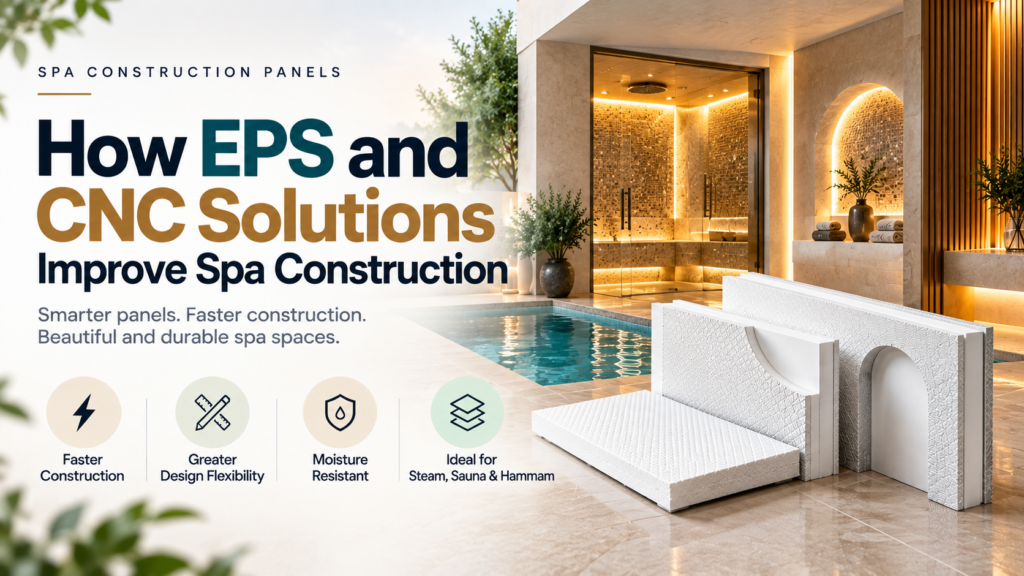
EPS-based panel systems and CNC-shaped components can help contractors and designers create customized structures while simplifying the fabrication of walls, ceilings, benches, niches, curves, and other architectural elements. Instead of relying entirely on conventional masonry and extensive on-site shaping, certain parts of a project can be planned, fabricated, and installed more efficiently.
For architects, contractors, hotel developers, and wellness businesses, understanding how these solutions work can help during the planning stage.
This guide explains how spa construction panels, EPS solutions, and CNC fabrication can improve different aspects of spa construction, while also examining their applications in spa room construction and wellness center construction.
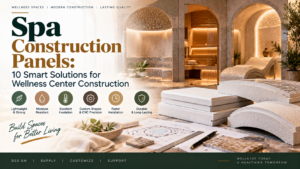
Spa construction panels are specialized construction components used to create different structural and architectural elements within spa and wellness environments.
Depending on the system, panels can be used for walls, ceilings, partitions, benches, platforms, niches, curved structures, and other customized features.
Many systems use an EPS core because expanded polystyrene is lightweight and provides thermal insulation. The core can then be combined with appropriate surface layers or reinforcement depending on the intended application.
The exact construction of a panel matters. A product designed for a standard interior partition should not automatically be used in a steam room or high-temperature environment.
The correct system should be selected according to factors such as temperature, moisture, waterproofing, structural requirements, surface finish, and applicable building standards.
For specialized projects, CNC technology can further improve the usefulness of panel systems by allowing components to be shaped according to digital drawings.
A spa is not simply another commercial interior.
Different areas of a wellness facility can have very different environmental conditions. A reception area may have normal indoor conditions, while a steam room can be exposed to high humidity and elevated temperatures. A sauna has its own thermal requirements, while shower areas need careful water management and drainage.
This means material selection needs to be based on the intended use of each space.
Traditional construction methods can be effective, but they may require several separate processes for specialized shapes.
For example, creating a curved bench using conventional masonry may involve blockwork, manual shaping, plastering, curing, waterproofing, and finishing. Each stage requires labor and coordination.
A suitable panel system can simplify some of this work by providing a lightweight base that can be shaped and prepared for finishing.
That does not mean panels eliminate the need for skilled construction. Instead, they can help make specific parts of the project more controlled and efficient.
EPS, or expanded polystyrene, is a lightweight cellular material widely used in insulation and construction applications.
Its low weight and thermal-insulating properties make EPS useful in situations where reducing the weight of a construction element and controlling heat transfer are important.
EPS panels for wellness centers can be considered for applications such as partitions, insulated structures, curved features, benches, and other components, depending on the manufacturer’s specifications.
One important point is that EPS itself is not a complete solution for every spa environment.
A steam room, sauna, wet room, or thermal space requires a properly designed assembly. Waterproofing, vapor control, surface finishing, ventilation, drainage, joints, and temperature limitations all need to be considered.
The panel should therefore be evaluated as part of the complete construction system rather than as an isolated material.
CNC stands for Computer Numerical Control.
In construction and fabrication, CNC equipment can cut and shape materials according to digital designs. This can be especially useful for wellness projects where architectural elements include curves, repeated shapes, or precise dimensions.
CNC panels for spas can be produced based on detailed drawings, allowing manufacturers to create components with controlled dimensions.
For example, a designer may create a curved seating structure digitally. Instead of manually shaping the entire structure on-site, the design can be converted into fabrication data and used to produce the required components.
This approach can offer several advantages:
CNC fabrication is particularly useful when a project contains multiple identical or closely related components.
One of the biggest challenges in modern spa design is turning an architectural concept into a practical construction solution.
Wellness interiors frequently use curves, rounded corners, built-in seating, recessed niches, decorative forms, and unusual geometries.
Creating these elements with traditional materials can involve extensive manual work.
Spa construction panels can provide a more flexible base for customized designs. When CNC fabrication is added, components can be shaped according to specific digital drawings.
This makes it easier to produce architectural elements that would otherwise require considerable site fabrication.
The result is not simply a more attractive space. It can also make the construction process easier to coordinate.
Construction materials can become difficult to transport and position when they are large or heavy.
EPS-based components are lightweight compared with many conventional masonry materials.
This can make handling easier during spa construction, particularly when materials need to be transported through existing buildings, narrow access points, elevators, or upper floors.
Lightweight components can also reduce the physical effort involved in positioning certain architectural elements.
However, lightweight construction does not mean structural requirements can be ignored. The complete system must still be designed and installed according to the intended loads and application.
Temperature management is important in spaces such as saunas, steam rooms, and other thermal wellness areas.
The thermal performance of a room depends on the entire building assembly, including insulation, joints, doors, ceilings, ventilation, heating equipment, and surface finishes.
Insulated spa construction panels can form part of this assembly.
Because EPS provides thermal insulation, EPS-based construction systems can help reduce heat transfer when properly designed.
For spa room construction, this can be especially relevant where maintaining different temperatures between adjacent spaces is necessary.
The exact thermal performance should always be based on tested product data and the complete wall or ceiling assembly rather than assumptions about the EPS core alone.
Manual cutting and shaping can result in small differences between components.
That may not matter for a simple partition, but it becomes more noticeable when a project contains repeated architectural features.
For example, imagine a wellness center with twelve identical curved benches.
Producing every bench manually can create variations in dimensions and shape.
With CNC fabrication, the same digital design can be used to produce multiple components with consistent dimensions.
This makes CNC panels for spas particularly useful for larger projects with repeated features.
Curved architecture is common in contemporary wellness design.
Rounded benches, curved walls, circular niches, wave-shaped structures, and organic forms can make an interior feel more distinctive.
However, curved construction can be labor-intensive when built entirely from conventional materials.
CNC shaping allows panel components to be fabricated into specific profiles.
These components can then be assembled and finished according to the project requirements.
This is one of the areas where the combination of spa construction panels and CNC technology can provide a significant practical advantage.
Built-in seating is common in steam rooms, hammams, relaxation areas, and treatment environments.
Standard furniture does not always work well in these spaces because the seating may need to follow the shape of the room.
Custom EPS spa components can be produced for project-specific requirements, subject to the product system’s structural and environmental limitations.
A custom bench can be designed around:
This allows seating to become part of the architecture rather than an item added after construction.
Large wellness facilities often contain several specialized rooms.
A typical project may include treatment rooms, showers, relaxation areas, steam rooms, saunas, changing rooms, and service spaces.
Wellness center panels can be used to create partitions and specialized structures where the selected system is appropriate.
Panel-based construction may also be useful during renovation because components can be easier to handle within an existing building than heavy masonry materials.
For developers planning phased renovations, this flexibility can be valuable.
Niches are useful in spa environments for storing products, towels, lighting, and decorative elements.
Creating a niche with conventional construction can require additional cutting and finishing.
With customized fabrication, niches can be incorporated into the panel design.
This is another potential application for custom EPS spa components.
For example, a steam room may include several recessed areas for lighting or toiletries. Instead of treating each feature as a separate construction problem, the components can be incorporated into the overall design before installation.
Digital fabrication encourages better planning.
When a component is being produced through CNC machining, dimensions need to be defined before fabrication.
This encourages architects, designers, contractors, and manufacturers to coordinate details earlier.
Openings, curves, dimensions, niches, service locations, and other details can be reviewed before production.
This can help reduce unnecessary modifications during installation.
For large wellness center construction projects, early coordination can be especially important because multiple contractors may be working in the same area.
Perhaps the most important advantage is the ability to think about spa rooms as complete systems.
A steam room, for example, is not simply four walls.
It may require:
Using spa construction panels as part of an integrated design can help different elements work together.
This approach is more effective than selecting construction materials individually without considering how they interact.
Wellness center panels can have several applications depending on the design and technical specifications of the system.
They may be used for:
Partitions can separate treatment rooms, changing areas, relaxation spaces, and service zones.
Suitable insulated systems can be used to create walls, ceilings, benches, and other structures.
Panels with appropriate thermal specifications can form part of a sauna enclosure.
Curved benches, walls, platforms, and decorative elements can be created using customized components.
Lightweight panels can be used for certain internal structures and partitions.
CNC fabrication can help create curved or customized architectural details.
The correct application always depends on the product specifications and environmental requirements.
EPS panels for wellness centers can provide benefits related to weight, insulation, and shaping flexibility.
However, choosing the right product requires more than checking whether the panel contains EPS.
Before selecting a system, project teams should ask:
These questions become particularly important for spa room construction, where moisture and temperature conditions can vary significantly.
CNC panels for spas are most useful when the project requires precision or complex geometry.
They can be particularly valuable for:
CNC fabrication works best when the design is finalized before manufacturing.
Frequent design changes after production begins can increase waste, delays, and fabrication costs.
Therefore, accurate drawings and good communication between the designer and manufacturer are essential.
Every wellness project has its own requirements.
A compact urban spa may need to maximize every square meter, while a luxury hotel spa may prioritize large curved structures and customized interiors.
Custom EPS spa components can help accommodate these differences.
Rather than forcing the design to fit standard construction shapes, customized components can be developed around the available space.
These components may include:
Customization should always be balanced with practical considerations such as installation, waterproofing, finishing, maintenance, and structural requirements.
Choosing the right spa construction panels requires looking at the project as a whole.
Determine whether the component will be exposed to water, humidity, steam, heat, or normal indoor conditions.
Review insulation performance, temperature limitations, fire properties, strength, dimensions, and installation requirements.
Tile, stone, mosaic, plaster, or another finish can affect the preparation required for the panel.
If the project contains curves or unusual shapes, ask whether CNC fabrication and custom components are available.
Electrical wiring, plumbing, lighting, drainage, ventilation, and heating systems should be considered before fabrication.
A good panel system still requires proper installation. Joints, fixings, waterproofing, reinforcement, and finishing should follow the manufacturer’s recommendations.
The material itself is only one part of a successful project.
Some common mistakes include choosing a panel without checking whether it is appropriate for the intended temperature or moisture conditions.
Another mistake is assuming that every EPS panel is suitable for steam rooms, saunas, or wet areas.
Poor waterproofing is another serious concern. A panel system should be integrated with an appropriate waterproofing strategy rather than treated as automatically waterproof.
Other mistakes include:
Good planning before fabrication can prevent many of these issues.
A successful wellness project depends not only on the materials but also on the experience behind their design and installation.
When evaluating a supplier or construction partner, look for clear technical specifications, customization capabilities, fabrication support, installation guidance, and experience with specialized wellness environments.
For projects involving spa construction panels, it is useful to discuss the design before fabrication begins.
Providing architectural drawings, dimensions, intended use, environmental conditions, and finishing requirements can help the manufacturer recommend a suitable solution.
For complex wellness center construction, early collaboration can also help identify potential problems before materials reach the site.
Modern spa construction requires construction systems that can accommodate both technical requirements and creative architectural designs.
Spa construction panels can provide a practical option for creating insulated walls, ceilings, partitions, benches, niches, and customized structures. When combined with EPS technology and CNC fabrication, these systems can offer additional flexibility for projects that require lightweight construction and precise shapes.
EPS panels for wellness centers can contribute thermal insulation and easier handling, while CNC panels for spas can help produce accurate and complex architectural forms.
At the same time, custom EPS spa components allow designers to create project-specific features instead of relying only on standard shapes.
For spa room construction and larger wellness center construction projects, the most important consideration is choosing a system that matches the actual environment. Temperature, moisture, waterproofing, structural requirements, finishing materials, ventilation, drainage, and building regulations all need to be considered.
When these factors are planned from the beginning, panel-based construction can become a useful part of creating efficient, customized, and modern wellness spaces.
For businesses planning a complete wellness project, ThermaCraft Wellness offers solutions designed around specialized environments such as steam rooms, saunas, hammams, and other wellness spaces. From spa construction panels and customized EPS solutions to specialized construction systems, exploring the right materials at the planning stage can help contractors and designers coordinate insulation, structure, finishing, and design requirements more effectively. If you are working on spa construction, spa room construction, or a larger wellness center construction project, explore ThermaCraft Wellness solutions for specialized wellness environments and custom construction requirements.
Thermal performance and insulation are important considerations when designing temperature-controlled wellness environments. The U.S. Department of Energy provides technical guidance on insulation, heat flow, and air sealing that can help readers understand the role insulation plays in building performance. This background can be useful when evaluating spa construction panels, EPS panels for wellness centers, and other insulated construction systems. Readers can refer to the U.S. Department of Energy’s insulation guidance for additional information on insulation and building-envelope considerations.